Oslo District Court has found Grindr’s sharing of personal data illegal as a result of the Norwegian Consumer Council complaint from 2020. Accordingly, Grindr has to pay EUR 5 million, as fined by the Council.
Our guardians of personal data and privacy: NDPA, NPAB, and NCC
As we have written multiple times in our blog series about GDPR and consequences of this EU-regulation, Norway has a long history of protecting citizens’ personal information. It started out with the first Personal Data Act implemented in 1978 with the purpose of protecting the individual against privacy being violated through the processing of personal data. The law was updated with GDPR clauses in the year 2000.
In 1980, the Norwegian Data Protection Authority (NDPA) was established as an independent authority whose task is to monitor compliance with the Personal Data Act. It is important to note that the NDPA has two roles: supervisory authority and ombudsman.
The NDPA decisions may be appealed to NPAB, Norwegian Privacy Appeals Board (Personvernnemda), whose decisions are final.
During recent years, another Norwegian governmental public body, the Norwegian Consumer Council (NCC), whose role is to protect consumers’ interests, has become involved in privacy, more precisely the misuse of personal data that big tech companies are involved in. As a governmental-independent agency, the NCC is free to chose the cases they want to work on.
Sharing of personal data is illegal without specific consent: The Grindr case
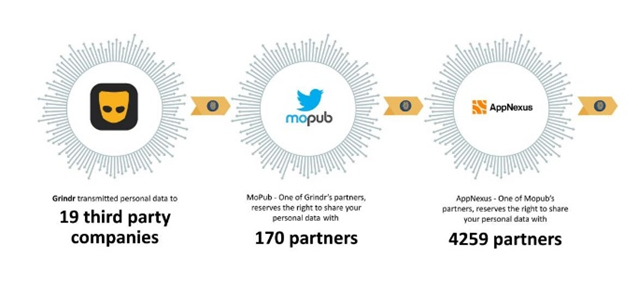
Recently, the NCC has put effort into the task of preventing the big tech companies from using personal information for surveillance-based marketing that the users have not consented to. Neither have users given consent to how personal data is transmitted to the companies’ partners.
The figure below, from https://noyb.eu/en/eu-58-million-fine-grindr-confirmed, illustrates the problem.