As we approach the end of 2025, we want to take a moment to reflect on the year and express our heartfelt thanks to you, our Runbox community. We’re a small, independent company, and while we always strive for excellence we know there’s room to grow. This year has been a journey filled with both achievements and challenges, and we are grateful for your support.
With Runbox, you can choose from a wide range of domain names to craft an email address that’s uniquely yours. Whether for personal or professional use, select a domain that complements your name, reflects your brand, highlights your location, or showcases your personality. Make a lasting impression with an email that truly stands out.
Privacy concerns in the online world aren’t new. We already know that big tech collects our personal data through “free” services, that data brokers profit off that data, that AI is scraping our social media for added profiling, and that governments utilize various surveillance technologies. But with the rapidly changing global landscape of threats to freedom of expression and personal liberties, there is a new level of concern for the need for privacy. Here, we point to some recent developments that may have an impact on privacy protections and personal data. Below you will also find a list of safe and private alternative services.
In our previous post on the AI Act, we concluded with a remark concerning the AI Act and the GDPR (General Data Protection Regulation): Are the two regulations aligned, or are there contradictions?
In this post we want to explore this question.
NOTE: When speaking about personal data and data subjects in the following, it is in the context of the GDPR. In addition, our concerns about AI and GDPR are mainly directed at general-purpose AI systems (GPAI-systems)where large amounts of (scraped) data is used to train the GPAI-modelon which the GPAI-system is built. (See box F below for exact definitions.)
The scope of the AI Act is comprehensive – it applies to any actor and user of AI systems within the jurisdiction of the European Union law, regardless of the actor’s country of residence.
As the GDPR, the AI Act is a regulation, contrary to a directive, which means that EU member countries have to implement it in their own legislation with only minor adaptive changes. The AI Act has EEA (European Economic Area) relevance as well, which means that the AI Act has to be implemented in Norwegian legislation – as the GDPR was.
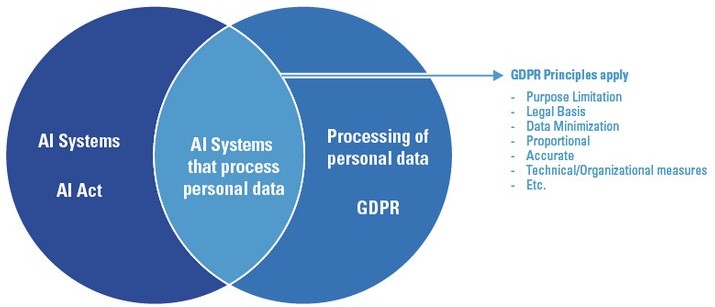
Intersection between AI and Privacy regulation [Source]
The diagram shown illustrates the situation: There are some obvious overlaps because AI systems may process personal data, and so GDPR principles apply.
On that basis, we could say “end of story” and “case closed”. However, there are some differences and potential conflicts, making it worthwhile to spend some time on the issue.
It is beyond the scope of this blog post to cover all aspects of the issue at hand, so let’s discuss the fundamentals, with what’s most relevant to Runbox in mind.
At Runbox, we believe that email should be sustainable, secure, and private. In a world where many major email providers are part of sprawling ecosystems that track your every move and monetize your personal data, we’ve taken a different approach. We provide a service that focuses solely on one thing: your email. No distractions, no ads, and absolutely no data mining. Just email.
As an independent email provider based in Norway, we are proud to offer a service that places your privacy and security first. With over two decades of experience, we’ve built Runbox with a simple mission in mind: to provide a reliable, privacy-respecting email service that empowers you to communicate freely and securely. You know where your data is stored (and it’s not floating around in the cloud).
The internet has transformed how we communicate, access information, and connect with each other, but it can be challenging to navigate the mix of accurate information and misleading content. Fact-checking and content moderation are ways to help shine a light on confusing or inaccurate claims as we try to make sense of what we encounter online. And while fact-checking is crucial for ensuring the accuracy of information, some will argue that fact-checking and content moderation is a threat to free speech. This raises important questions about the role of online platforms and what responsibility they have to their users. Here we explore where fact-checking stands today, how platforms are handling content moderation, and the impact these changes are having.
We’ve said it before, and we’ll say it again. The need for data privacy and the ability to communicate freely has never been more critical. Both individuals and businesses rely on secure online communication to safeguard sensitive information, especially as surveillance technologies continue to monitor and exploit digital interactions. At Runbox, we believe that privacy is more than just a feature; it is the core value that guides our service and our operations. Located in Norway, we are deeply committed to user privacy, which is supported by the country’s strong legal framework. Here, we explore why our location is vital for your privacy protection and how it aligns with the General Data Protection Regulation (GDPR).
January is often a time when we reassess and reorganize. After the holiday rush and the chaos of the previous year, the start of a new year feels like the perfect moment to take a step back and refocus. For many of us, this often means decluttering our physical spaces—cleaning out closets, sorting through old items, and clearing off countertops. But what about our digital lives?
In today’s digital world, email phishing scams are one of the most common and dangerous threats to individuals and businesses. These deceptive emails attempt to trick recipients into revealing personal information, clicking on malicious links, or downloading harmful attachments. Phishing attacks can lead to identity theft, financial loss, and even security breaches for organizations. For Runbox users, these scams can specifically target your email account and compromise your sensitive data. But by staying vigilant and following a few key practices, you can protect yourself from these scams.
Do you use email aliases? Aliases are a great tool that can help protect your identity, reduce spam, and organize your inbox.
Aliases are alternative email addresses that you can use to separate emails. Instead of using the same address for everything, you set up different aliases for online subscriptions, registrations, newsletters, social media, business contacts and so on. Any category that works for you. You can use your main address for friends and family, or create another alias.
All your aliases are set up under your main email account, and is delivered to your primary inbox. You can even set up filters so that mail is separated into specific folders in your account.
Not only will aliases give you another layer of anonymity, it also gives you control over your information and makes online tracking more difficult. Having aliases can help prevent someone hacking your main email account, and helps protect you from phishing attacks. If one of your aliases starts to receive lots of spam, you can easily delete the alias and set up a new one.